
Skill Pal:
Finding Your Soft Skills.
“ There is no formula that guarantees professional success, but we all have observed the importance that social and emotional intelligences plays in career advancement. ”
Background
This was a school project for Design Thinking course at the University of Washington Professional Continuing Education. The course itself has driven us an theoretical foundation, essential research insights and practical concept testing evaluation.
Ying Xiao and I decided to carry this project forward to not only focus on user research but also improve information architecture, design strategy and usability.
My Role
User Research, Product Design, Interaction Design, Prototyping
Team
One Product Manager, One User Researcher, Two Designers
Duration
8 weeks
Research & Design Process
👀Objectives & Hypothesis
Problem Space
Audience Research - User Interviews
Executive Summary
📚Methods & Synthesis
Behavioral Archetype
Journey Map
Secondary Research
💡Ideation & Design
Concept Catalog
Storyboarding
Wireframing
✍️Evaluation & Deliver
Usability Testing
Hi-fi Prototypes
Design Spec
PROBLEM
There is no formula that guarantees professional success, but we all have observed the importance that social and emotional intelligences plays in career advancement. Understanding people’s underlying motivations, anticipating their needs, and successfully collaborating and communicating with coworkers are skills often learned through time consuming personal trial and error.
Therefore, I raised the question:
How Might We help professionals become aware of their blind spots and accelerate learning soft skills to help them excel?
SOLUTION
Interaction Prototype
AUDIENCE RESEARCH
Individuals know soft skills are important especially for relationships and are aware of the challenges in improving.
“First (for how to form strong soft skills), look at yourself and get the status quo.To observe, compare do well & do not do well distinction, find people who is doing well and find feasible solutions on their own, supplemented by the help of related books, scientific training.”(Jeremy Zhang interview, 2020)
“(Soft skills)”are necessary not only in the workplace, but also outside too.” (Fatema Mohamedali interview, 2020)
“It's going to be more work in the near future, but like in the long run, the idea is you will get a better job and like your future overall will be better off.” (Jonathan Schaeffer interview, 2020)
“It's important you know being able to communicate and interact socially just getting through everyday life.Whether you're at work or even going into the store things don't happen as easily as it may be if you possess those soft skills.” (Michael Anderson interview, 2020)
EXECUTIVE SUMMARY
The Situation - Soft skills are a critical part of workplace success but don’t get the unaided recognition they deserve.
Soft skills are valuable assets that are critical to success in both relationships and the workplace. Having the right soft skills can help individuals elevate in their eld or job and gives them the ability to handle situations tactfully. Unfortunately without prompting, soft skills are not often actively or consciously considered or focused-on.
The Tension - Learning soft skills has a significant amount of perceived risk and it’s easier to stay the same.
While both studies and individuals can attest to the positive results that come from improving soft skills, there are many obstacles that make this process challenging and overwhelming, discouraging individuals from trying.
💰 Cost:Leadership and soft skill development conferences and classes are expensive.The cost of time and energy required to improve soft skills is also prevalent.
🎲Risk: Developing soft skills can have (perceived) inhibiting risks including fear of failure, self-doubt, and embarrassment.
🏆Recognition and reward: Soft skills are typically not actively acknowledged and rewarded like hard skills are so there are fewer incentives to improve.
📚Resources: “How to improve soft skills” yields over 200 million results on Google.There is an overwhelming amount of information which makes it difficult to identify and prioritize the best information for an individual’s learning style and needs.
⚖️Measurement: Soft skills are hard to quantify and measure improvement in to validate progression and development.
The Opportunity - Reduce the inhibitors and create a more favorable environment to develop soft skills.
We can enable individuals’ soft skill development with motivation, confidence, and ability to progress by creating a more comfortable environment, and reducing or removing inhibitors.
💰 Cost: Providing concise, digestible content online or through an app can be a potentially cheaper and more convenient sustainable solution.
🎲 Risk: Creating content and reminders that challenge thoughts of doubt or fear of failure can instill confidence.
🏆Recognition and reward: Creating more awareness of the benefits of soft skills and encouraging incremental rewards and how to share their achievements with others can encourage continued improvement and practice.
📚 Resources: Providing assessments to identify/prioritize skills an individual would most bene t from developing and how to create a sustainable, easy plan (with multiple method options to practice in an ideal environment) can ease the process.
⚖️Measurement️: Enabling individuals to create a plan with progress checkpoints along the way to validate improvement could develop a stronger sense of accomplishment and motivation along the way.
SYNTHESIS
1. Market Summary
Value Exchange Map
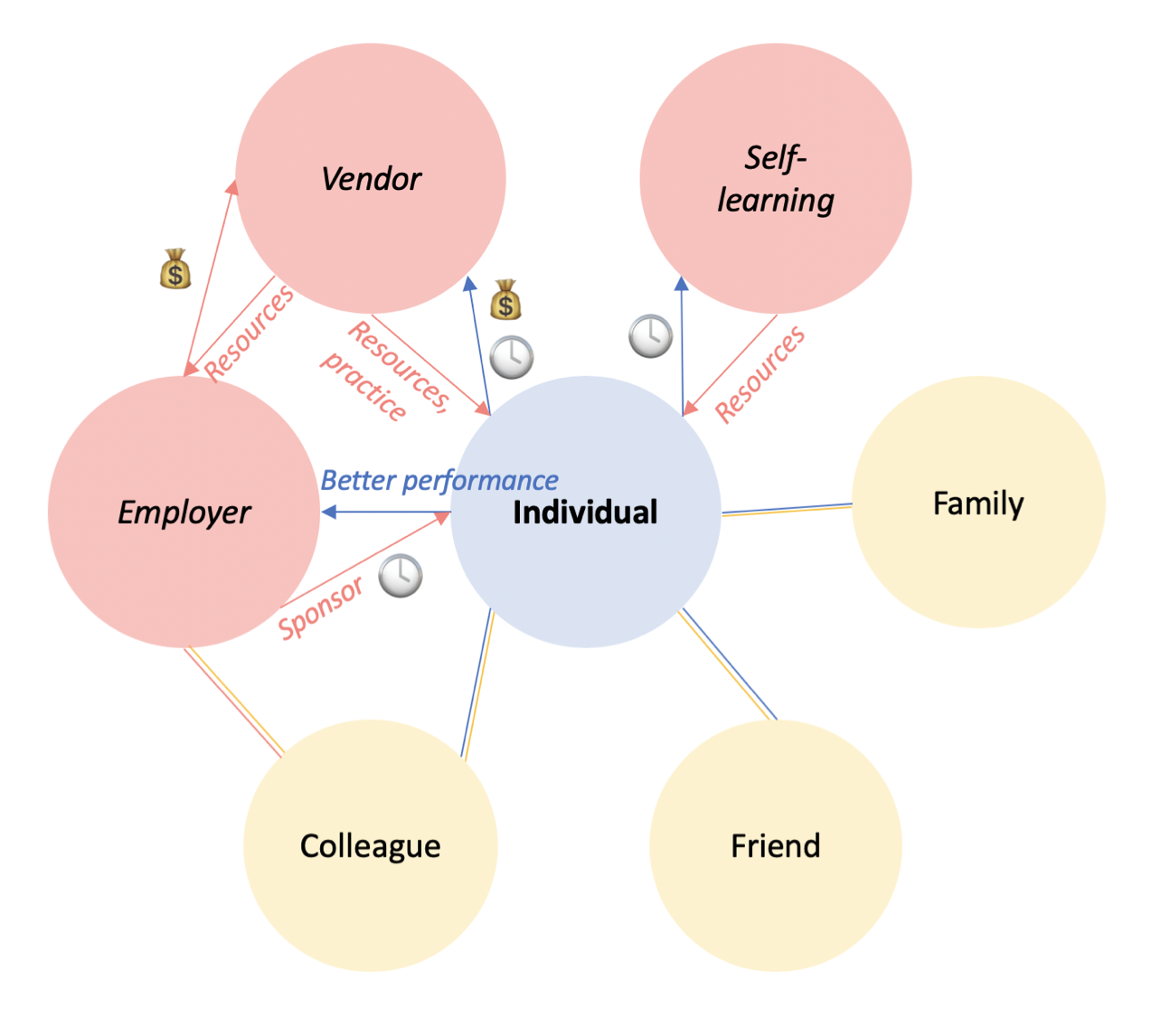
Value Exchange Map
No matter what provider an individual uses, there is still a need for time and energy investment on the individual’s end to improve soft skills.
Soft skills have the potential to positively or negatively impact relationships in both your personal and professional life.
Colleagues are uniquely positioned when improving soft skills because they are connected to the workplace and the individual.
2. Competition Summary
Competition Analysis
Competition Analysis for 3 Types of Products
Leaders
There are many online entities that offer soft skill learning, but some are more popular/recognizable.
“We’ve(Coursera) curated this collection of courses on ‘soft’ skills that help you achieve success in your career, as well as other aspects of your life. Become an expert on effective communication, negotiation, conflict resolution, resume writing, interview skills, and learning techniques.”
Disruptors
Employees tend to use executive education to develop soft skills but some stand out.
“The one-day UW Soft Skill Workshop will help you gain a better understanding of key soft skills and how they can complement your existing skill set. Soft skills are multifaceted and can include interpersonal skills, social skills, communication skills, attitudes, and teamwork and leadership abilities.Typically, soft skills are more difficult to measure, but they are immensely valuable, especially as your career progresses.”
3. Culture Summary
Organizational Behavior
Soft skills are perceived to be critical for success in the workplace.
“92% of nearly 900 surveyed executives said soft skills were equally important or more important than technical skills, yet 89% said they have a ‘very or somewhat difficult’ time finding employees with those soft skills.” (WSJ, 8/30/16)
Behavioral Science
Individuals must see value to stay highly motivated and overcome obstacles to improve their soft skills.
“No learning environment is perfect/optimal, and barriers to learning soft skills include financial, time, and effort costs, which some decide are simply not worth the effort and abandon completely. (Diane Sumner and Walden University, 2015).”
“Challenges of developing soft skills (Training Industry, 2019): - Hard to measure - Require repeated effort - Some soft skills are harder to learn than others because of personal characteristics (shyness for example) -You can’t teach someone to enjoy performing a soft skill - Complexity as these skills require self-reflection and depth.”
METHODS
1. Behavior Archetype
Based on extensive audience research and executive summary that we have observed and conducted firsthand, we generated this sticky cluster and categorized them to three archetypes: Goal-Getter, Curious-Seeker and Passive Participant.
Behavioral Archetype Sticky Clusters
👇Then we created 3 behavior archetypes worksheet including following characteristics: Goals, Needs, Pain-points, Thoughts, Feelings and Actions.
Behavior Archetype - Goal Getter
Behavioral Archetype Worksheet - Goal Getter
Behavior Archetype - Curious Seeker
Behavior Archetype Worksheet - Curious Seeker
Behavior Archetype - Passive Participant
Behavior Archetype Worksheet - Passive Participant
2. Journey Map
Journey Map for Goal-Getter + Curious Seeker + Passive Participant
IDEATION
1. Idea Generation
As a team, in order to solve the problems we identified, we generated various ideas and transferred idea cluster to concept catalog as our solutions. And we highlighted four ideas by Four Categories Method - Most Rational, Most Delightful, Darling and Long shot. Then generate our Concept Narrative Storyboarding.
Generating Ideas Worksheet - Concept Catalog
2. Concept Narrative Storyboarding
After selected 4 curated concepts in the last phase. We created 4 Concept Narrative Storyboards as our Low-fi Prototypes for concept feedback session.
Concept A - Measurement
Concept B - Steps
Concept C - Competitions
Concept D - Community
CONCEPT TESTING
1. Pre-study Questions
Behavioral Archetype Identification
During Pre-Study (3 minutes) section, we used this section to gain a better understanding of the user’s current experience. This section was used to explore the needs, pains, and goals of the user in the context of the experience you’re trying to improve.
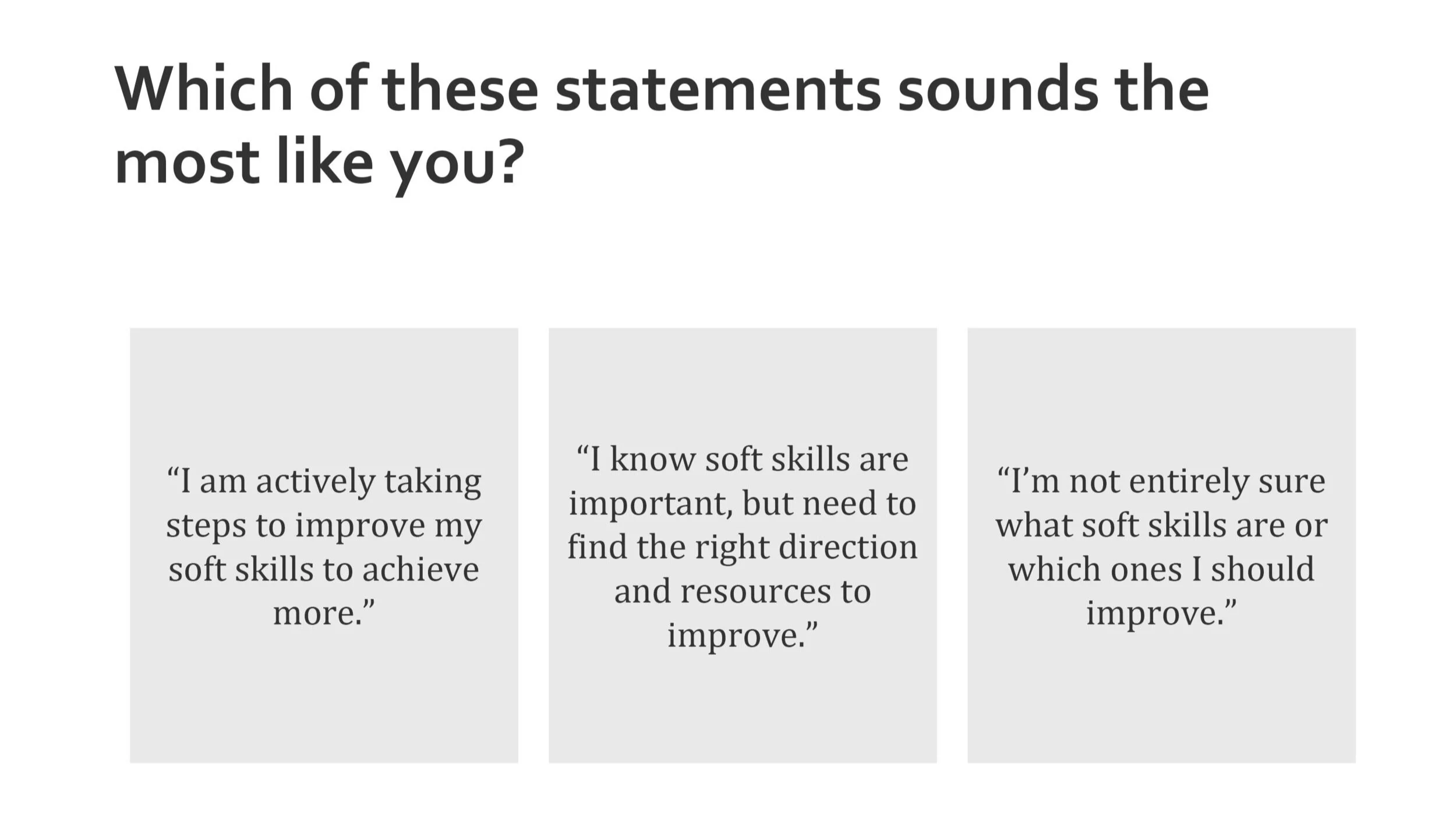
Behavioral Archetype Identification Question
2. Concept Feedback
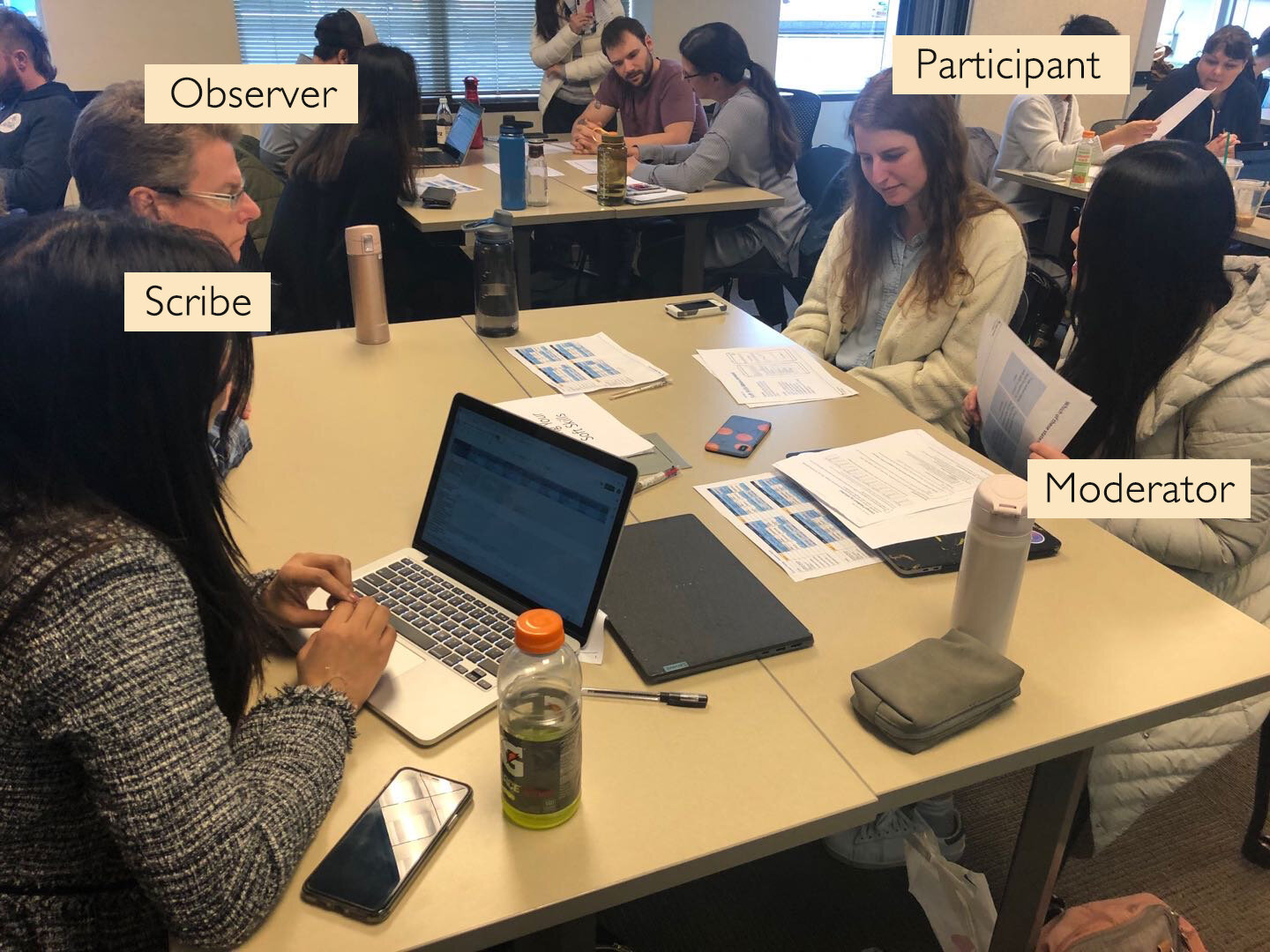
Our group was doing concept testing, I was acted as moderator for this participant.
General Questions
- Out of the four concepts I just shared, which concept would be the most helpful to you to learn soft skills?
- Could you explain to me why you think this concept would be the most helpful to you?
Corresponding Questions
- Which features would be most helpful to you?
- Which features would be least helpful to you? • If this concept was available today, would you take advantage of it?
- How con dent are you that this app would help you achieve your goal? (For Concept A)
- Would you consistently log your milestones/progress? (For Concept B)
- Under what condition, would you feel bored with the competition? (For Concept C)
- What is your expectation for mentor-mentee programs and what kind of interactions you want to experience most through the community? (For Concept D)
- For the other concepts tell me why it would not be helpful to you?
3. Post-study Questions
After capturing concept feedback from the participant, we used this section to wrap-up the study and probe for any final thoughts or feelings.
Survey
We handed out a quick survey response form to the participant and have them complete it.
Finished Surveys from 5 Participants
DESIGN & EVALUATION
From problems to solutions
Scoping
After capturing concept feedback from the participants, we used this section to wrap-up the previous study and probe for any final thoughts or feelings. Then we prioritized issues by severity and matched key problems with features and solutions for scoping.
Scoping Stickies
After solution scoping, we were prioritizing our features through 2x2 matrix as our criteria, aiming to confidently prioritize what to build next based on user feedback and clear strategic criteria.
We sorted all issues under categories and decided to redesign within focus areas. We finally decided to focus our design on 4 areas as our navigation bars and their related feature elements as follows:
Focus Area
Community
Event Search
Mentorship
My Progress
Feature Elements
Adaptive Pre-test
Recommendation Mechanism and Sharing platform
Event Search by Preference and Recommendation
Pre-quiz for Best Mentor Matches
One-on-One Tailored Study Mentorship
Skillset Information Visualization Showing Progress
Connections for Peer Learning
Wireframes
We started with defining the overall wireframes of the platform:
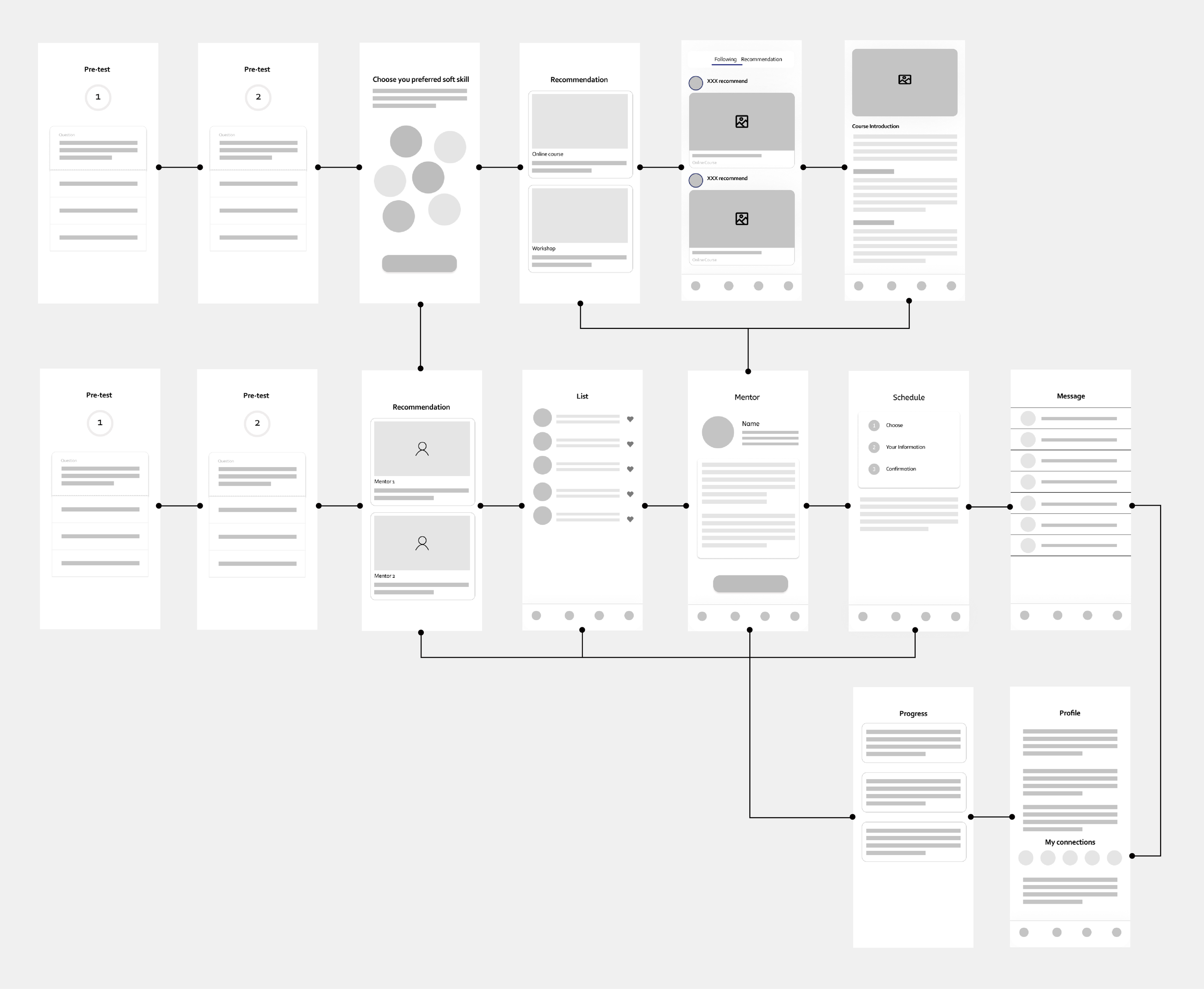
Generating Wireframes
Mid-fi Prototypes
Then, we created Mid-fi wireframes for usability studies
New Users’ Pre-test and Recommended Events
Pre-test and Recommendation
Home Pages Moments Sharing Showing Courses & Meet-ups and Event Search System
Home Pages and Event Search Page
Mentorship Pre-quiz and Favorite List and Schedule
Mentorship Pages for New Users
Set & Send Time Availability through One-on-One Messages
Time Availability and Messages for Old Users
User Progress Checkin and Personal Profile
Progress Checkin and Profile
FINAL DESIGN
How we solved the problems
Refining IA (Information Architecture)
Initial IA
Modified IA
Managing Customization - Customizable Signup & Event Search
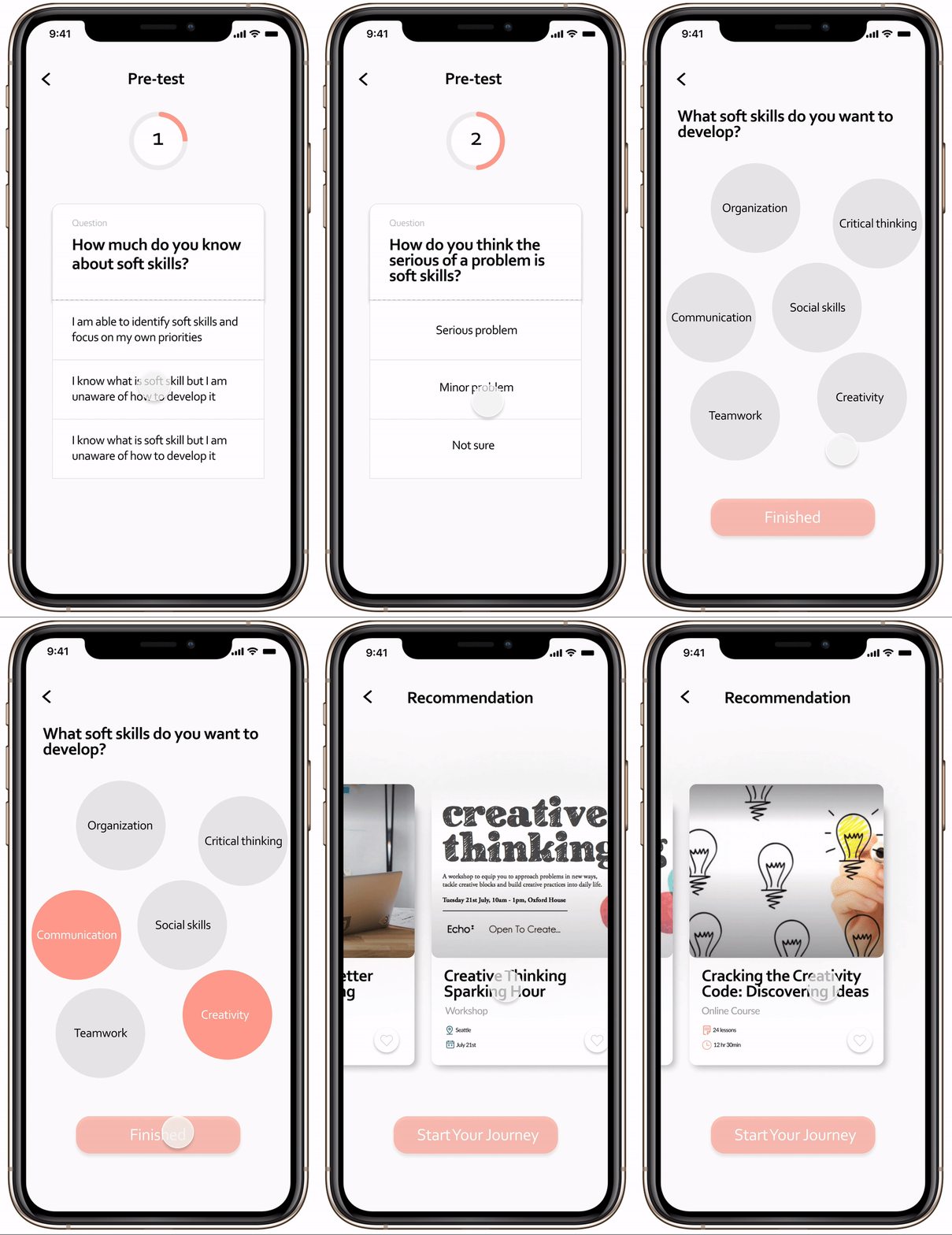
Sign up with Tailored Pre test
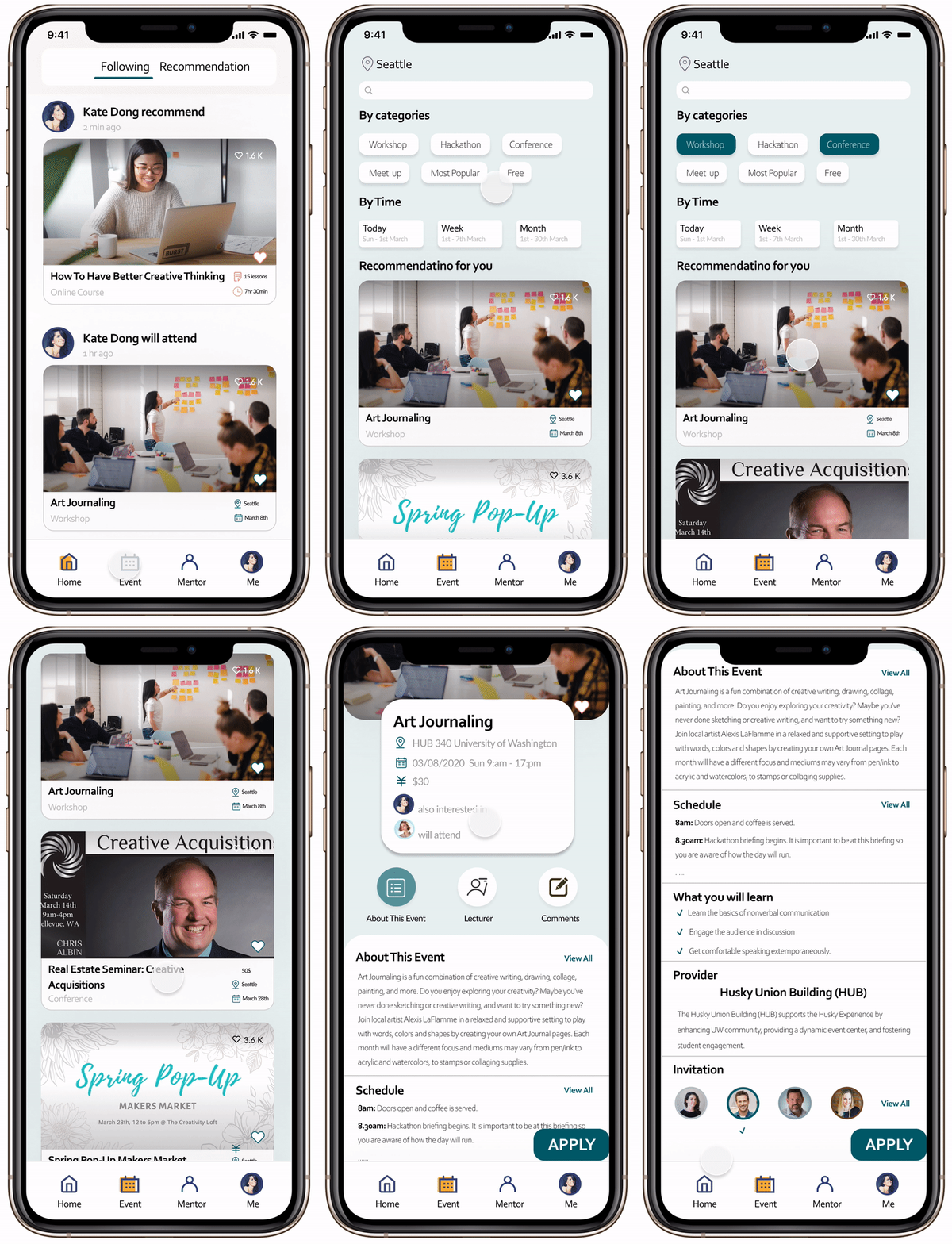
Search by Preference & Flexibility
Including pre-test to evaluate ongoing soft skills level and guidance on refining focus areas based on results
Search events based on users’ preference and flexibility
Bringing Tailored Mentorship Program - One-on-One study mode

Mentorship for New Users
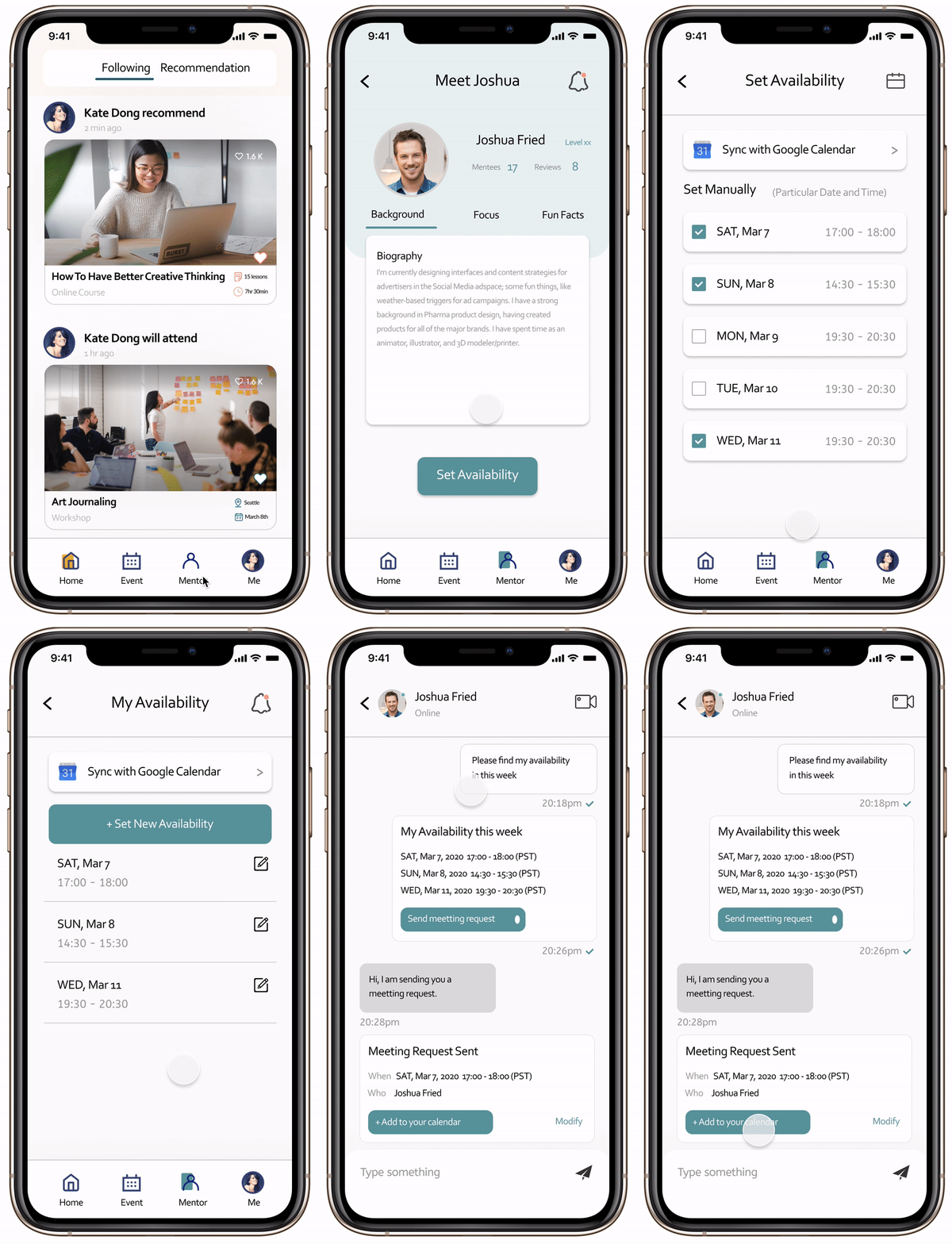
Mentorship for Old Users
Providing a customizable mentor-mentee program for one-on-one tutoring to meet the needs and enjoyable experiences for both new users and old users
Fostering Sense of Belongings & Building Evaluation System
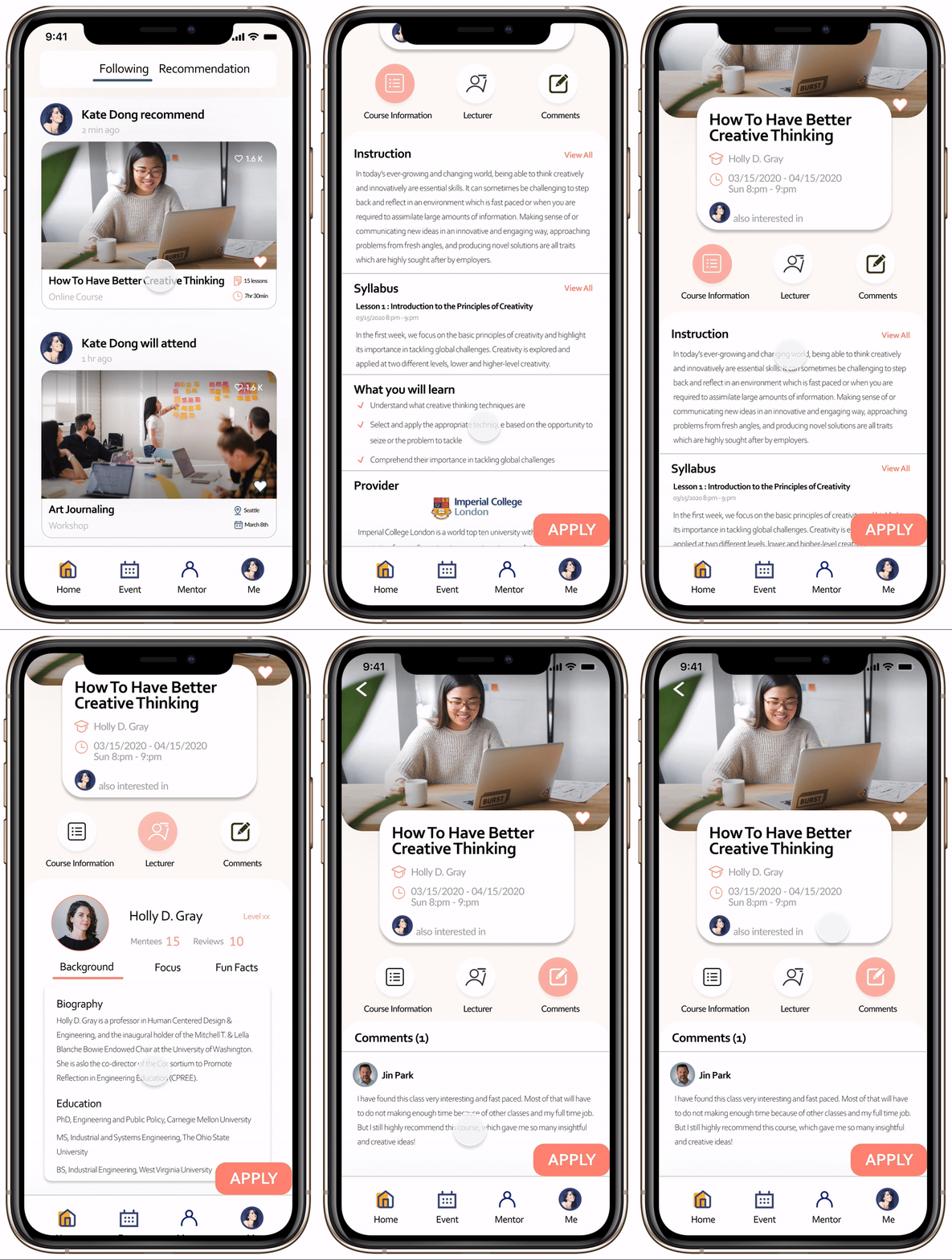
Sharing Community
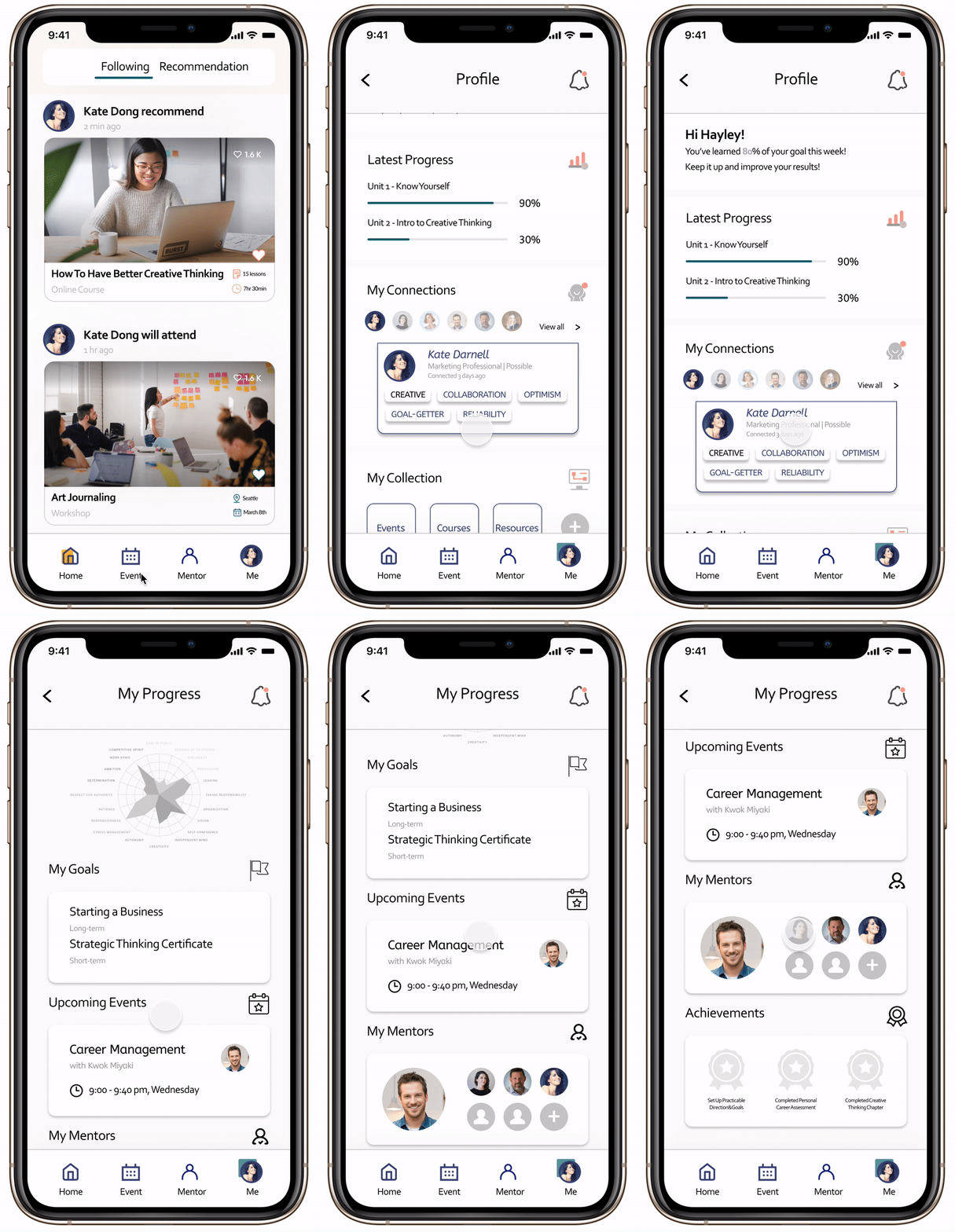
Evaluation System
Keeping track of users preference and learning process through adaptive recommendation mechanism and creating community platform for experience sharing
Information Visualization integrated in progress checkin for skillset growth and achievement & rewards
TAKEAWAYS
Use usability studies to pivot on actionable items
By listing out and prioritizing issues found in usability testing, we successfully narrowed down our scope and focused on details.
Considering the user needs and the organization's goal at the same time
After we found the usability issues, we could come up with a lot of different good ways to solve the problems. The current design decision could be made because we tried to solve the fundamental problems and understanding of the core purpose of this mobile platform by interviewing the professionals.